
Feature · Zellige
The art of zellige
From the grey clay of Fez to the sixteen-pointed star of the al-Attarine madrasa, zellige is geometry cut with a hammer. Tesserae, constructions, gestures and monuments: what we learned from the masters and the books, so that our patterns are true.
Sixteen-pointed rosette with 45° points — the family of the al-Attarine and Bou Inania panels in Fez. Exact construction, at the scale of a rosette about 20 cm wide.
History
A thousand years of glazed earth
Born in Ifriqiya, perfected by the Marinids of Fez and the Nasrids of Granada, zellige has never stopped being cut in Morocco.
-
10th – 11th century
Ifriqiyan beginnings
The oldest fragments come from Sabra al-Mansuriyya in Tunisia. At the Qalʿa of the Banu Hammad in Algeria (1068–1091), green eight-pointed stars already alternate with cross-shaped tiles.
-
12th century
The Almohads, green and white
The Koutoubia minaret in Marrakech bears the oldest dated zellige in Morocco: plain green and white bands. The tiles were pierced and nailed to a wooden frame.
-
14th century
The Marinid golden age
In Fez, the al-Attarine (1323–1325) and Bou Inania (1350–1355) madrasas cover floors, dados and pillars with tiny tesserae: sixteen-pointed rosettes, eight-pointed stars, even pieces under 2 cm.
-
14th century
Granada and alicatado
At the same time the Alhambra develops the same technique, known in Spain as alicatado. In the Mirador de Lindaraja some pieces are barely 2 mm. Seville takes it up in the palace of Peter I (1364–1366).
-
16th century
Saadian splendour
In Marrakech the Ben Youssef madrasa (1564–1565) continues the Marinid tradition, and the Saadian tombs under Ahmad al-Mansur are often seen as the peak of zellige.
-
17th – 18th century
Meknes and the great gates
Under Moulay Ismail and his successors zellige leaves the courtyards: completed in 1732, Bab Mansour in Meknes fills its lozenge network with polychrome tesserae.
-
20th century – today
Fez, a living conservatory
The great families of Fez maâlems restored the monuments and trained today’s workshops. An experienced cutter still shapes up to a thousand pieces a day, by hammer.
The word zellige comes from the Arabic zalaja, “to slide”, after the smooth surface of the glaze. The Spanish azulejo derives from it too.
The tesserae
Furmah, the pieces of the puzzle
Each cut piece is called a furmah. Craftsmen tell hundreds of them apart (one scholar counted 360) and name them in Darija. Here are six, drawn from our own patterns, in their true proportions.
-
Khatem soulaymani
Solomon’s seal
The eight-pointed star: two equal squares, one turned by 45°. It is the mother piece of the eight-fold system that dominates the zellige of Fez and Granada.
In our patterns: 8.0 × 8.0 cm
-
Qamarchouna
The pointed cross
The cross that locks between four stars. Its V-shaped notches take exactly the points of the neighbouring khatems.
In our patterns: 8.0 × 8.0 cm
-
Msedds
The hexagon
In the khatem field these elongated hexagons link the eight-pointed stars to the four-pointed ones. All their angles derive from the octagon.
In our patterns: 6.0 × 5.0 cm
-
Mkhammes
The pentagon
Around a twelve-pointed star, twelve pentagons form the crown. It belongs to the twelve-fold system, the system of the square root of three.
In our patterns: 3.5 × 2.8 cm
-
Mtemmen
The octagon
The heart of eight-fold rosettes: the regular octagon at the centre of the khatem, and the base polygon of the whole system.
In our patterns: 4.8 × 4.8 cm
-
Louza
The almond
An elongated lozenge with 45° and 135° angles. In pairs, louzas double the points of a star, turning twelve points into twenty-four.
In our patterns: 5.0 × 2.1 cm
Names recorded by the linguist Chakib Hoummad (2018) from André Paccard and interviews with Fez craftsmen. A piece’s size depends on the pattern’s scale: the same cross is 1 cm in a fine panel and 8 cm in a floor.
The craft
From kiln to wall, the maâlem’s hand
Zellige is a chain of specialists: potters, glazers, cutters (nqaach), layers (fraach), under the eye of the maâlem, the master who carries the patterns in his memory.
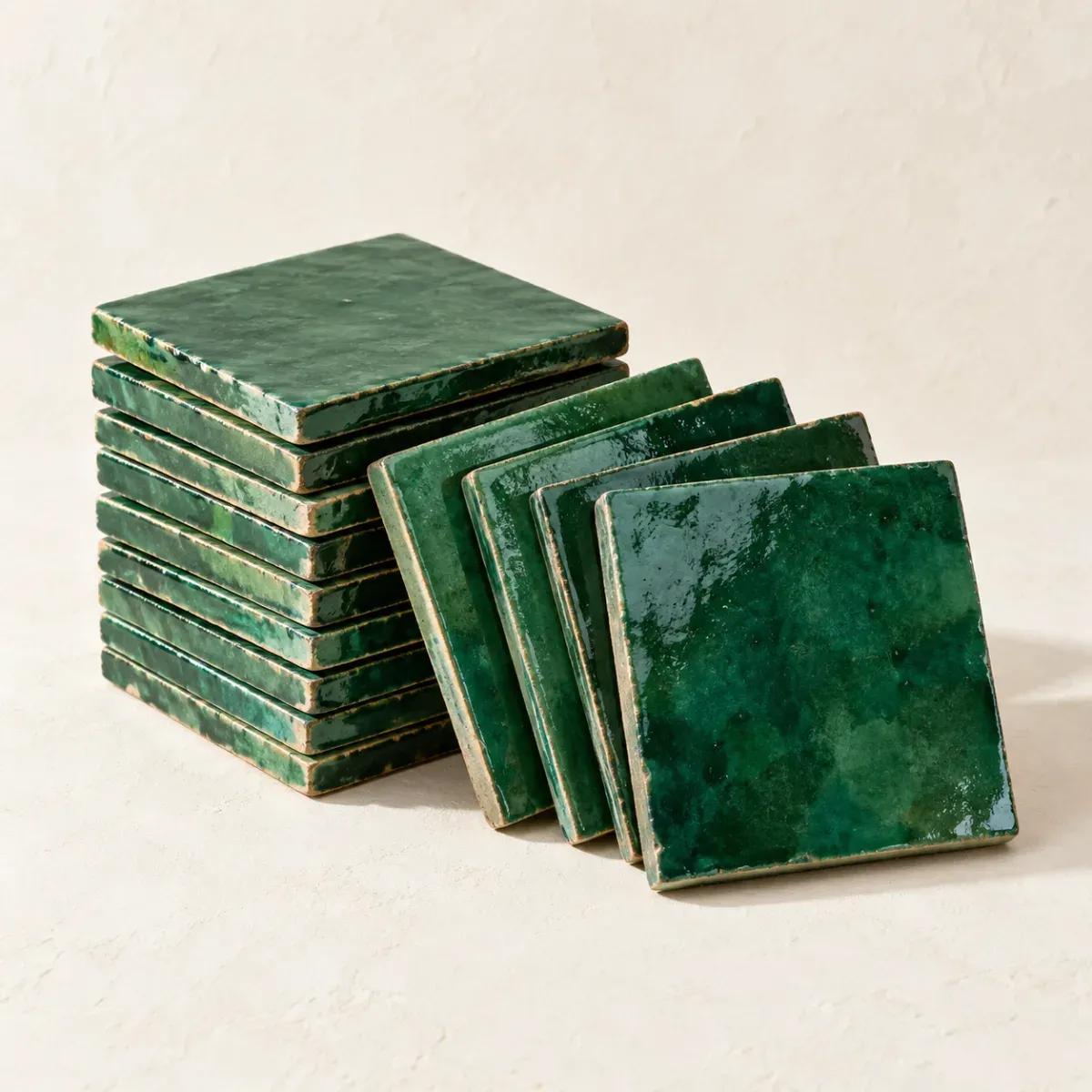
- 10 × 10 cm
- the glazed tile the pieces are cut from
- 360
- piece shapes recorded
- 1,000
- pieces a day for an experienced cutter
- ≈ 5,000
- pieces in a one-square-metre fountain panel
-
The grey clay of Fez
Dug from the hills around Fez (Jebel Ben Jelliq), the clay, rich in illite and kaolinite, soaks in basins, rests, then is moulded into 10 cm tiles on a bed of ash.
-
Two firings and the glaze
A first firing gives the biscuit; one face is dipped in glaze, then the tile goes back into a kiln fired with olive pomace. Green comes from copper, black and blue from minerals.
-
The maâlem’s drawing
The master draws the pattern, usually from memory, with ruler and compass: a network of squares and octagons, or of triangles and hexagons, from which the stars arise.
-
Cutting with the menqach
The nqaach traces a template on the tile, scores it with a bevelled hammer against a steel anvil, then breaks off the piece. A finisher bevels the back so that only the glazed edges will touch.
-
Laid face down
The fraach assembles the panel upside down, glaze to the floor, starting from the centre: the rosette first, then the rings. He works without seeing the pattern, from memory.
-
Pouring and lifting
Mortar is poured on the back (plaster and lime in the past, cement today); once set, the panel is turned over and fixed to the wall in one piece.
The monuments
Where to see zellige
From Fez to Seville, the places where the masters fixed the grammar of zellige. Dates are those of construction.
-
Qalʿa of the Banu Hammad
Pavements of eight-pointed stars and cross-shaped tiles: one of the first milestones of Maghrebi zellige.
-
Koutoubia minaret
The oldest dated zellige in Morocco, in green and white bands, under the Almohads.
-
Al-Attarine madrasa
Dados and pillars of extreme finesse; a sixteen-pointed rosette with 45° points, repeated later at the mausoleum of Moulay Ismail in Meknes.
-
Alhambra, Comares palace
The alicatado dados of the Hall of the Ambassadors, under Yusuf I and Muhammad V. In the Mirador de Lindaraja, pieces of 2 mm.
-
Bou Inania madrasa
Panels with sixteen, eight, five and ten-pointed stars; the minaret combines zellige with a lozenge network (darj wa ktaf).
-
Alcázar, palace of Peter I
The Mudéjar masterpiece: craftsmen from Granada, Toledo and Seville, zellige dados and the Nasrid motto.
-
Ben Youssef madrasa
Founded by the Saadian sultan Abdallah al-Ghalib: its zellige dados faithfully continue the Marinid tradition.
-
Saadian tombs
Under Ahmad al-Mansur, the Hall of Twelve Columns pairs Carrara marble, cedar and zellige, often held as the art’s peak.
-
Bab Mansour
By the architect Mansour al-ʿAlj: for the first time a monumental gate whose lozenge network is filled with polychrome zellige.
-
Medina of Tetouan
Refounded by Andalusians from Granada, it has its own zellige: pieces are cut before firing, hence wider joints and softer colours.
-
Chellah necropolis
The ruins of the Marinid necropolis keep zellige fragments contemporary with those of Fez.
-
Mosque of Córdoba, mihrab
For reference: the dome of al-Hakam II’s mihrab is a Byzantine-style glass and gold mosaic, an Andalusian ancestor but not zellige.
The medallions show the dominant pattern family, redrawn by us: they are not surveys of the panels. The Mosque of Córdoba is listed for reference only: its mihrab is a Byzantine-style glass mosaic, not zellige.
Bibliography
The masters’ books
-
1979
Le Maroc et l’artisanat traditionnel islamique dans l’architecture
-
1996
Arabesques. Art décoratif au Maroc
-
2017
Islamic Geometric Patterns: Their Historical Development and Traditional Methods of Construction
-
2013
Islamic Geometric Design
In our collections
Zellige at home
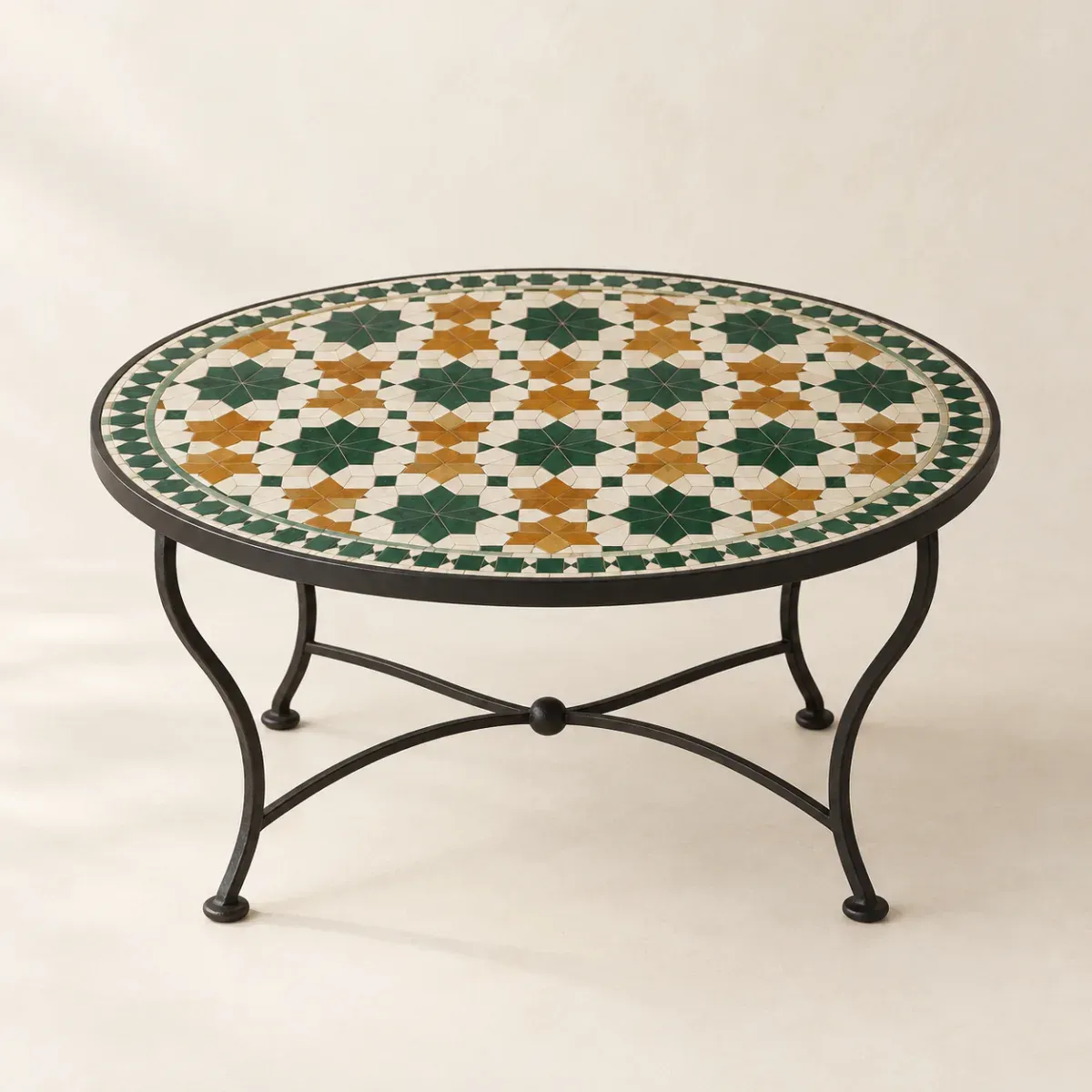
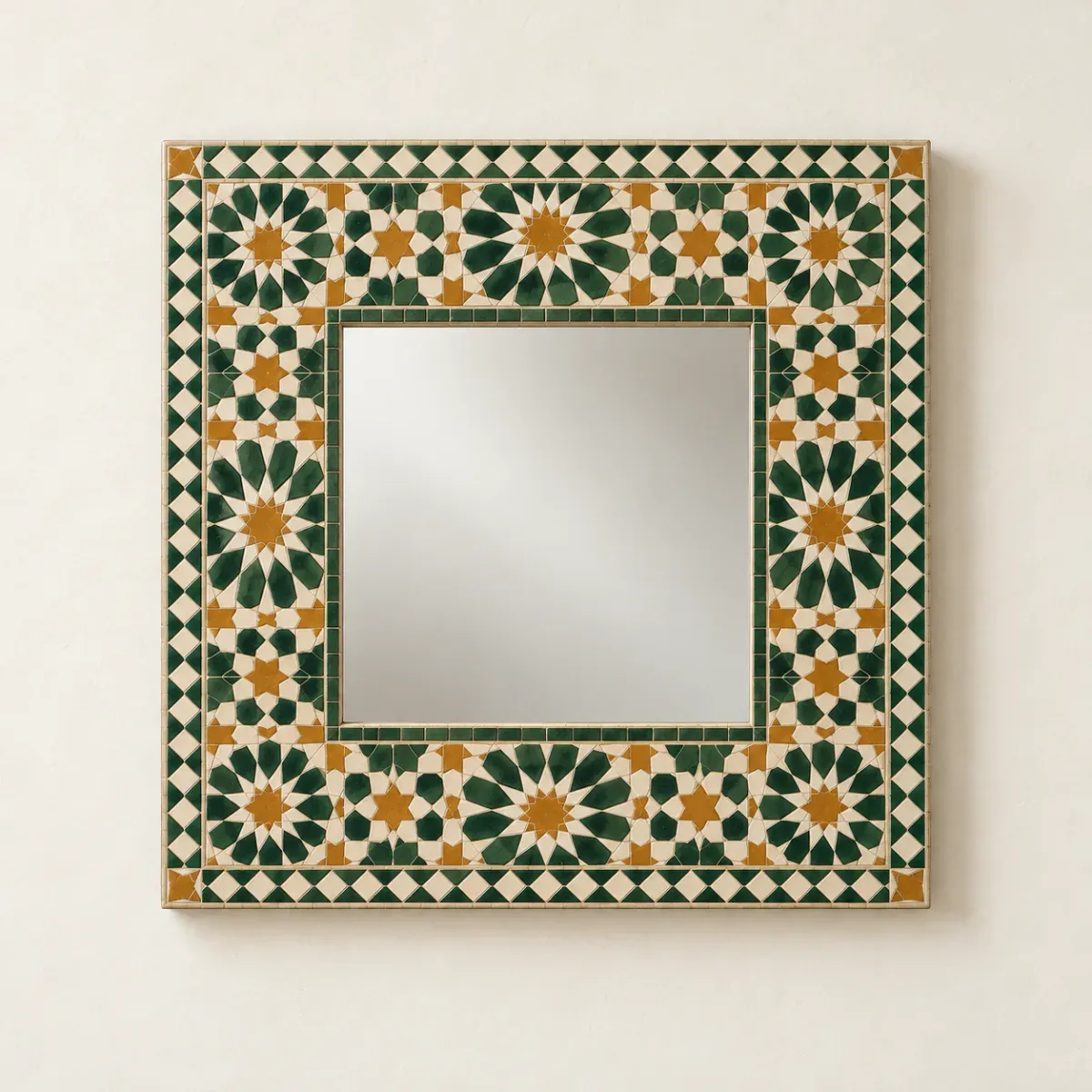
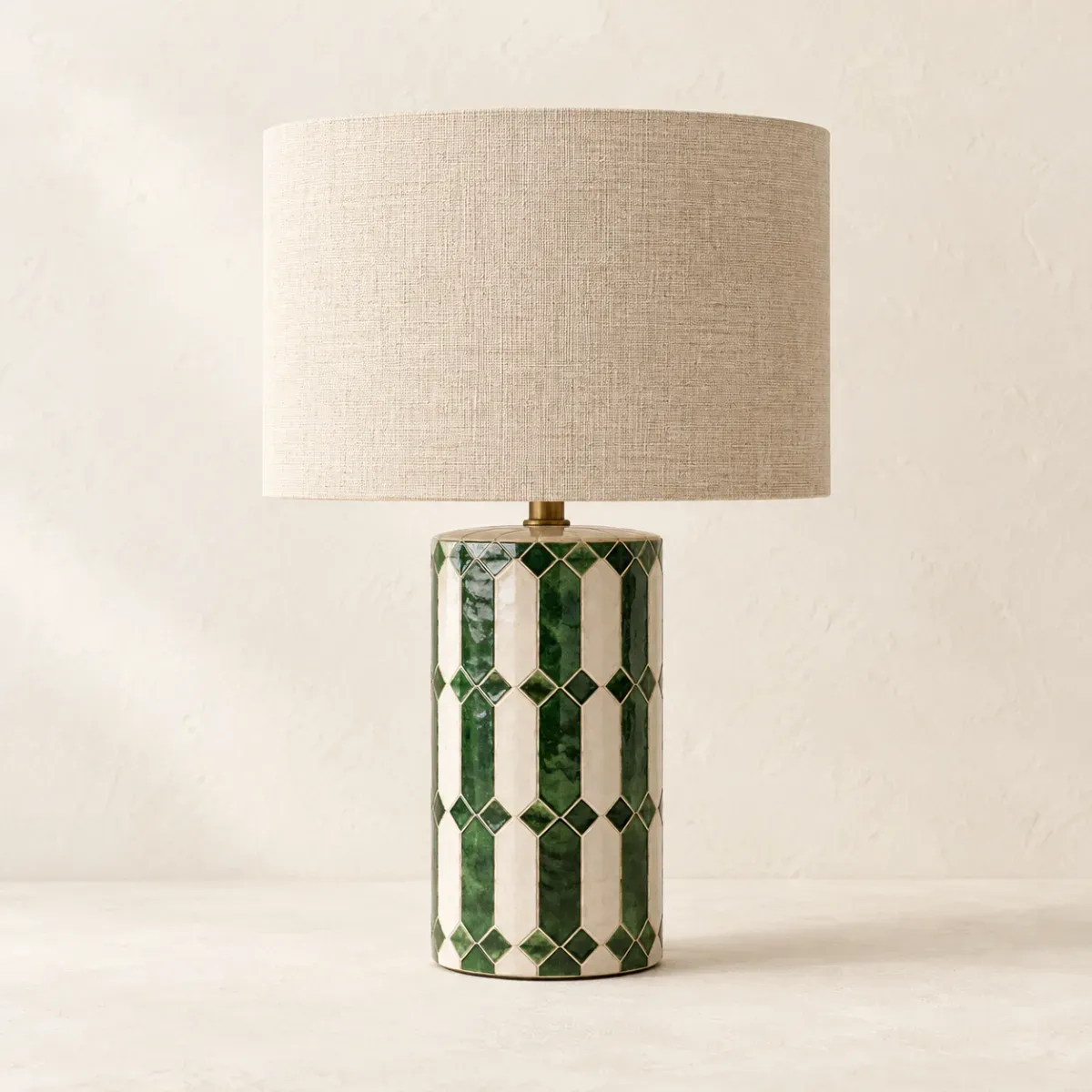
Tables, mirrors, lamps and tiles cut by hand in Fez and Tetouan.