
The art of leather · Craft
The leatherworker’s gestures
Cut, skive, sew, decorate, finish: a leather piece is a series of gestures that are simple to describe and long to master. We show them one by one, with what the sources say about them, and nothing more.
Sewing
Saddle stitch versus machine stitch
A leather seam is judged by what happens on the day a stitch breaks.
Saddle stitch, by hand one thread, two needles crossing in every hole
Lockstitch, by machine top thread and bobbin thread, locked half-way through
The saddle stitch is sewn by hand with a single thread carrying a needle at each end. The two needles pass through every hole in opposite directions: in each hole the two halves of the thread cross, and each stitch holds on its own.
A sewing machine makes a lockstitch: the top thread goes down into each hole and catches the bobbin thread half-way through the thickness. The stitches depend on one another: if one breaks and the end is pulled, the seam can come undone stitch after stitch.
| Saddle stitch | Machine stitch | |
|---|---|---|
| Threads | One, with a needle at each end | Two: top thread and bobbin thread |
| Where it holds | In every hole, the two halves cross | The two threads lock half-way through |
| If a stitch breaks | Only that stitch opens; the seam holds | The seam can come undone |
The French dictionary Trésor de la langue française distinguishes the true point sellier (saddle stitch), sewn by hand, from the machine-made “piqûre sellier” that imitates its look. On the face the two look alike; it is their construction that differs.
Cutting and skiving
The paring knife and skiving
The tranchet is a steel blade without a handle, “meant for cutting leather”. The word is recorded as early as the 13th century among shoemakers:
« Ne sueur ne cordoanier / Ne porroient lor cuir tranchier / Ne a coutel ne a trenchet »
To skive (parer) is to thin a hide to make it supple and to take the thickness off its edges. Without skiving, a turned edge would be too thick and an assembly seam would leave a ridge. The paring knife is held almost flat and lifts a bevelled shaving from the flesh side.
- Tranchet
- A steel blade without a handle, for cutting leather. A “paring” form exists.
- Skive
- Thin a hide to make it supple; remove the parts of the edges that are too thick.
- Turned edge
- An edge folded back on itself: it needs a skived edge to stay flat.
Decoration
Hot tooling and gilding
To tool (gaufrer) is “to print raised and sunken patterns, hot or cold”; the French word is recorded for leather in 1565. An engraved brass tool, heated, is pressed into the leather: the pattern sinks in and darkens.
To gild, a gold leaf is laid on the leather before the tool is pressed: the gold stays only in the impression, the rest is wiped off.
In Morocco this is bookbinders’ knowledge. In 1619, in Fès, al-Sufyānī devoted a treatise to it, The Art of Bookbinding and Gilding (Ṣināʿat tasfīr al-kutub wa-ḥall al-dhahab), edited by Prosper Ricard in 1919 and again in 1925.
Three ways to gild a cover
In 1612 the Spanish seized the library of the Saadian sultan Moulay Zaydan, now at the Escorial. Its Moroccan bindings are the reference for the 15th and 16th centuries; three styles of decoration can be told apart.
-
The central lozenge
The decoration gathers at the centre of the cover, in a lozenge.
-
Circular ornaments
The decoration is organised in circles and rosettes.
-
All-over decoration
The pattern repeats across the whole cover.
Diagrams of the principle, not drawings of specific bindings. Source: Collège de France symposium on Moroccan bookbinding in the light of the Escorial collection (2025).
Braiding
The flat three-strand braid
Three strips of leather and a single gesture, repeated: the simplest braid is also the strongest.
The gesture
The left strand crosses over the middle one and takes its place; then the right strand does the same. Repeat, tightening at each pass. The strips stay flat, and so does the braid.
What the animation shows
Every strand follows the same curve, shifted by a third of a turn: its sideways position varies as sin(t + φ), its depth as sin 2(t + φ). The result: a strand always passes over the same neighbour and under the other, as in the Borromean rings.
Where it is found
Handles, belts, borders, bracelets: it is a basic technique of all leatherwork. We found no serious source making it the speciality of any particular Moroccan city, so we claim none.
Embroidery
The gold thread of Fès
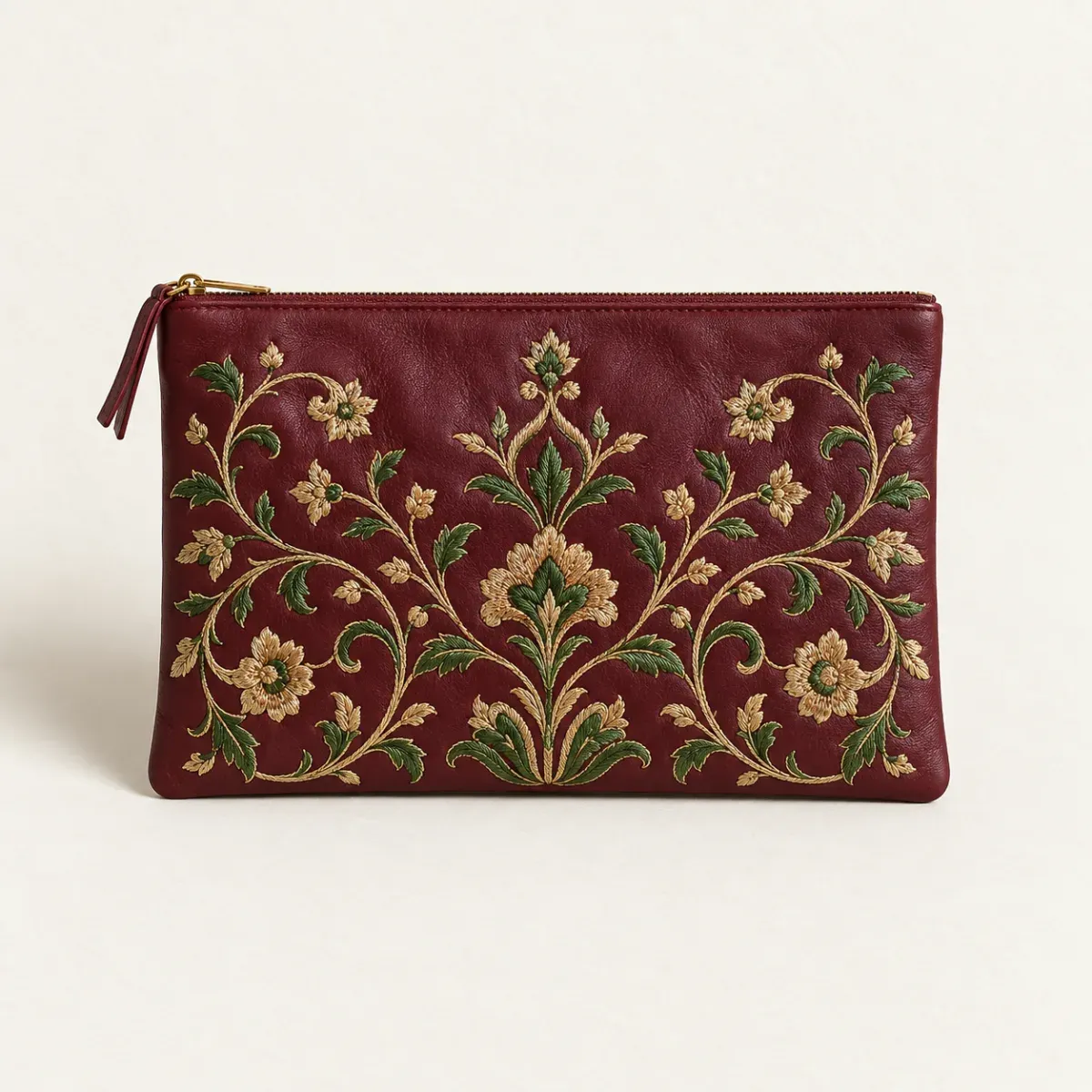
In Fès, gold thread is embroidered on velvet and on leather: bags, Qur’an cases, babouches, cushions.
It is couched embroidery: the gold thread stays on the surface, laid on the leather, and a second thread, of linen, crosses it in small stitches to hold it down. Anne-Marie Goichon described it in 1939 in the journal Hespéris.
The work was shared: men drew the design, women embroidered. The linen couching thread was called “hit susi”, because it came from Sousse; the gold thread was spun by Jewish craftsmen of the mellah until the middle of the 20th century.
-
teffaha
the apple: a circle
-
yasmina
jasmine: a flower
-
mressa
tears
-
guza
the walnut: an oval
-
zellij
squares and lozenges
Motif names after A.-M. Goichon (1939), as given by the Textile Research Centre in Leiden. Our drawings give the idea, not a record.
Finishing
Edges: sand, dye, burnish
The edge is the cut side of the leather, where its thickness and fibres show. Left raw, it frays and soaks up moisture. It is finished in four stages.
- Raw straight from cutting, the layers are not quite aligned and fibres stick out.
- Sand the layers are levelled, the corners taken off, and the edge sanded to a rounded profile.
- Dye an edge dye, applied with a dauber, colours the fibres.
- Burnish it is rubbed briskly, often with a little wax, until the fibres lie down and the edge shines.
A technique shared by all leatherwork. We found no source describing a specifically Moroccan way of finishing edges.
Fès · the babouche
The ziwani babouche: 24 steps, one workshop
In his workshop in Sbitriyine, in the Fès medina, maâlem Abderrahim Zerifi has been making the Fassi babouche for nearly forty years.
steps, all done in the same workshop, according to the maâlem
-
The hide
Goatskin, dyed bright yellow.
-
Cutting
The pieces are cut from the hide.
-
Sewing
They are sewn by hand with strong thread.
-
The insole
It is fitted inside the babouche.
-
The edges
They are smoothed to finish the piece.
What the Le360 report (2025) shows; the 24 steps are not detailed one by one.
The maâlem says the shape is “seven to eight centuries old”: that is his testimony, not an established date. In Moroccan Arabic the babouche is called “balgha”; the one from Fès, “ziwani”.
The French word “babouche” is recorded in 1542, as “papouch”. It comes from Persian pāpūš, “what covers the foot”, by way of Arabic and Turkish.
In short
From hide to piece
From the tanning vat to the shop window, the order of the gestures hardly changes.
-
Tan
The hide, dehaired and tanned, comes out of the vats and dries in the sun.
The tannery -
Cut
The pieces are marked out, then cut with the tranchet.
The tranchet -
Skive
The edges are thinned where they will be folded or sewn.
Skiving -
Assemble
The pieces are glued, pierced, then sewn.
The saddle stitch -
Decorate
Tooling, gilding or gold-thread embroidery, depending on the piece.
Tooling and gilding -
Finish
The edges are sanded, dyed and burnished.
Edges
Film
With the babouche makers of Fès
A short report by Agence France-Presse in the babouche workshops of Fès, in English.
Sources: TLFi (“tranchet”, “parer”, “sellier”, “gaufrer”, “babouche”); al-Sufyānī, 1619 (ed. P. Ricard); Collège de France, symposium on Moroccan bookbinding (2025); A.-M. Goichon, Hespéris 26 (1939), via the Textile Research Centre, Leiden; Le360 (2025) for the ziwani babouche.
Personalisation atelier
Your turn to choose
Leather, thread colour, tooled motif: design your card holder or wallet and see it in 3D.
Section map
All about Fez leather
Understand where morocco leather comes from, learn the gestures, then design your own piece.
Understand
eMaroc leather goods
Pieces cut and stitched by hand
Cowhide, goatskin or lambskin, saddle stitching and dyed edges: pieces made to last and to take on a patina.