
Compositions
The great rosettes
At the heart of a large zellige panel, a rosette radiates. Other rosettes ring it, and a field of cut pieces fills every gap without leaving a void. This is how such a composition is built, piece by piece: 977 tesserae, all drawn with ruler and compass.
From the heart to the edge
Scroll: the tesserae fall into place ring after ring, in the order the layer sets them.
-
The heart
A sixteen-point star and its sixteen petals. Workshops call the central rosette naʿoura, “the waterwheel”.
-
The sun of forty-eight rays
Honey rays, black threads, blue and yellow flames: forty-eight points, like the great rosettes Fez workshops call khamsini.
-
The sixteen satellites
Sixteen sixteen-point rosettes form a closed ring; each shares one side with each of its neighbours.
-
The field and the frame
The lines leaving the rosettes cross one another and outline the filler pieces, out to the frame of small bricks.

Anatomy
Reading a great rosette
Such a composition reads in rings. Each ring repeats a single shape, so the cutter can prepare the pieces in batches.
-
The heart
33 pieces
A sixteen-point star with 45° points, sixteen hexagonal petals and sixteen black lozenges that close the rosette on a thirty-two-sided polygon.
-
The sun
192 pieces
Forty-eight rays widening outwards, alternating with forty-eight tapering hollows; a ninety-six-sided polygon cuts them into two rings.
-
Lobes and arrows
64 pieces
The great star that holds the sun has sixteen points, each cut into a red dart and two white sides. Between them, sixteen sky-blue arrows reach towards the satellites.
-
The satellites
272 pieces
Sixteen rosettes like the heart, only smaller: a star and sixteen petals each. Their colours alternate, blue with yellow, red with sky blue.
-
The field
320 pieces
Hexagons (msedds), chevrons, white beads, points and grains: the pieces born where the lines between the rosettes cross.
-
The frame
96 pieces
A border of black and white bricks, six per side, on a sixteen-sided polygon.
Vocabulary
Words of the workshop
Only terms we could check in published sources appear here. Other names circulate; without a reliable source, we leave them out.
- Tastir تسطير
- From the root “to rule lines”: the body of geometric construction rules behind a pattern, rather than one particular drawing. Moroccan geometers study sixteen-point rosettes “in the tastir style” (Ouazene et al., 2022).
- Hasba and qasma
- Two methods of constructing Moroccan patterns, cited by the crystallographers Aboufadil, Thalal and Raghni (2013). Hasba starts from a grid drawn to exact measurements.
- Naʿoura ناعورة
- The “waterwheel”: the name of the central rosette. The lexicon recorded by Chakib Hoummad (2018) also gives it for a circular piece.
- Khamsini, miʾini
- The so-called “fifty” and “hundred” rosettes actually have 48 and 96 points: in this family the count must be divisible by six (Werner, AramcoWorld, 2001).
- Khatem soulaymani خاتم سليمان
- The “seal of Solomon”, an eight-point star of two crossed squares: the basis of the eightfold system, to which sixteen-point rosettes belong.
- Furmah
- A cut tessera, a “shape”. One researcher counted 360 different ones; many are named after everyday objects.
- Nqaash and fraash
- The cutter, who shapes the pieces with a hammer, and the layer, who draws the plan on the floor and assembles the panel. The maʿallem is the master who runs the workshop.
Geometry
Sixteen rosettes around one
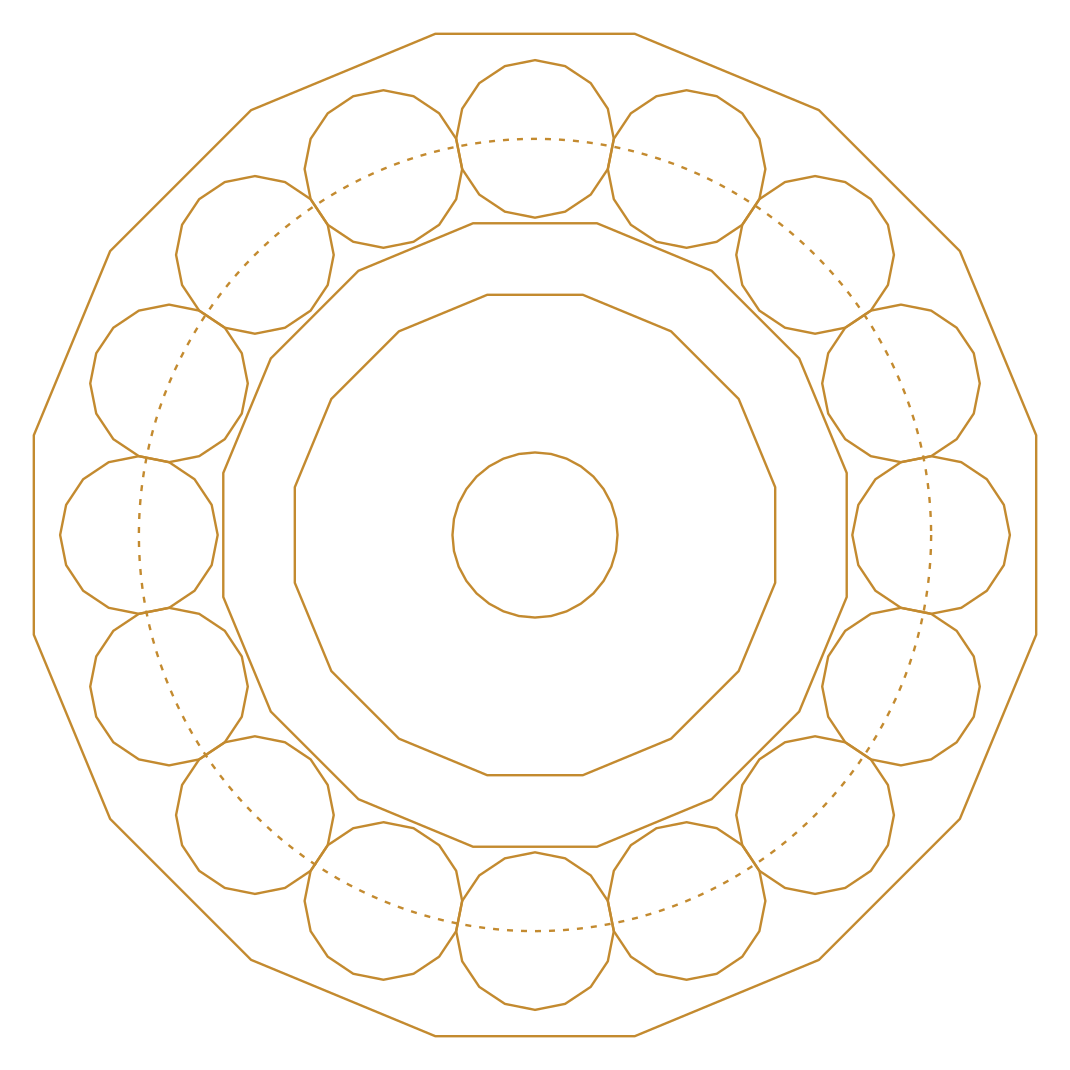
A sixteen-point rosette does not tile the plane. To ring it with similar rosettes, one starts from a tessellation of polygons “in contact”: here, sixteen regular hexadecagons set in a ring, each sharing one side with each neighbour, around a central hexadecagon and inside a hexadecagon that serves as the frame.
From the midpoint of every side two lines leave at the same angle, 33.75° from the perpendicular, and each runs until it meets another. This is the polygons-in-contact method, described by E. H. Hankin in 1925 and systematised by Jay Bonner. In each hexadecagon of the ring, the resulting star is replaced by its rosette: the outer sides of its petals are those very lines.
Where two rosettes touch, the lines cross; between three rosettes, irregular regions remain, filled with joining pieces. This is how incompatible symmetries are reconciled: each rosette keeps its geometry, and the filler pieces absorb the difference. Jean-Marc Castéra showed that in Moroccan zellige this skeleton follows an octagonal grid in which every angle is a multiple of 45°.
In relief
The panel, tile by tile
Here each tessera becomes a piece of glazed earthenware a centimetre thick, set on a bed of mortar. The pieces fall ring after ring and find their place; then turn the panel to watch the glaze catch the light.
As on a hand-laid panel, each tile is very slightly tilted: that is what makes a zellige wall shimmer.
Drag to turn the panel. Tap “Explore in 3D”, then turn the panel with your finger.
Where to see them
Great compositions, from Fez to Granada
High-order rosettes appear on dados, floors and fountains. We give a number of points only when it is documented.
-
Sahrij Madrasa
Among the oldest madrasa zellige still in place; its panels show the skeleton of stars and saft (irregular hexagons) studied by geometers.
-
Al-Attarine Madrasa
Zellige on dados, floors and pillars. Sixteen-point stars appear alongside eight-point stars, and crystallographers have found a quasi-periodic structure in its panels.
-
Bou Inania Madrasa
A panel of sixteen-point and eight-point stars gathers about 500 pieces in a single pattern unit; the madrasa also keeps a rare five- and ten-point system.
-
Ben Youssef Madrasa
The zellige dado of the courtyard, beneath stucco and cedar: the order “zellige, plaster, wood” in the Saadian period.
-
Saadian Tombs
Their dados carry even more complex sixteen-sided stars, in finer and thinner pieces than those of the Marinids.
-
Dar Batha
A palace turned museum (reopened in 2025), with zellige floors and fountains. It holds a panel in which a twelve-point star sits at the centre of a rosette, framed by eight-point stars.
-
Alhambra
In the Mexuar, small pieces form “wheels” around eight- and sixteen-point stars. In the Hall of Comares, the tiled dados carry eight-point stars and twelvefold motifs; its sixteen-point stars are in the stucco and the window grilles.
-
Alcázar of Seville, Hall of the Ambassadors
The palace of Peter I, built with craftsmen from Granada and Toledo among others, keeps window reveals faced with zellige; we found no precise survey of their rosettes.
-
Hassan II Mosque
The largest zellige project of the twentieth century: about a hundred qualified masters among some 170 zellige craftsmen, according to the mosque’s foundation.
-
Royal Palace, gates of Dar al-Makhzen
Gilded bronze doors framed with zellige, darj wa ktaf and muqarnas: the great Fez workshops still compose at this scale.
Rosettes of 48 and 96 points are documented as workshop categories, not attributed to a specific monument. Sources: our bibliography and research file.
Our composition
What this panel shows
This panel copies no monument. It is a composition built for this page by the rules described above, and checked to the millimetre by our generator. It uses the Fez palette: tin white, manganese black, cobalt blue, sky blue, honey, red, yellow and copper green.
- 977
- whole tesserae
- 21
- shapes of piece
- 8
- glazes
- 16
- axes of symmetry (8 for the colours)
- 1.06 m
- across
- 33.75°
- a single drawing angle
In our collections
Zellige at home
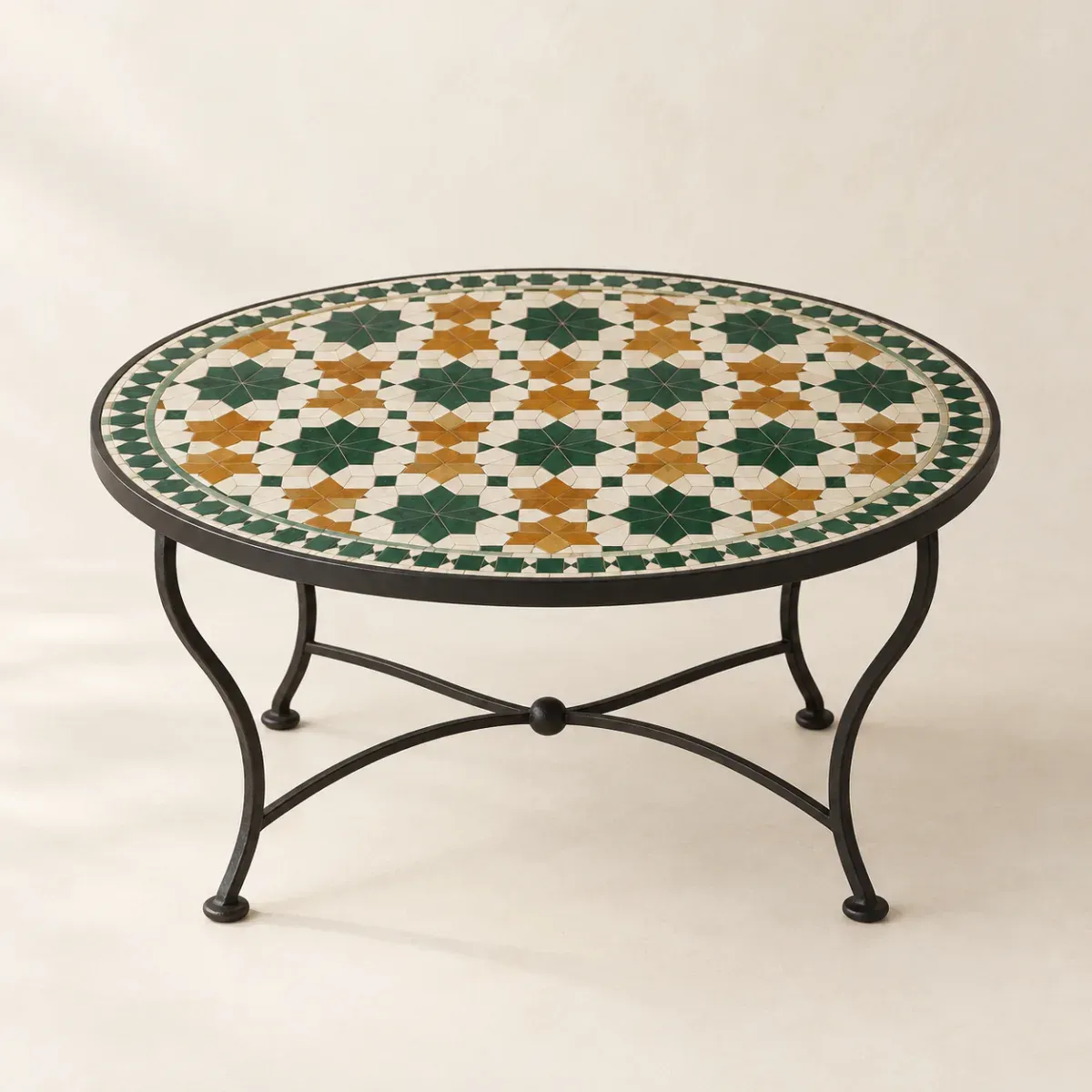
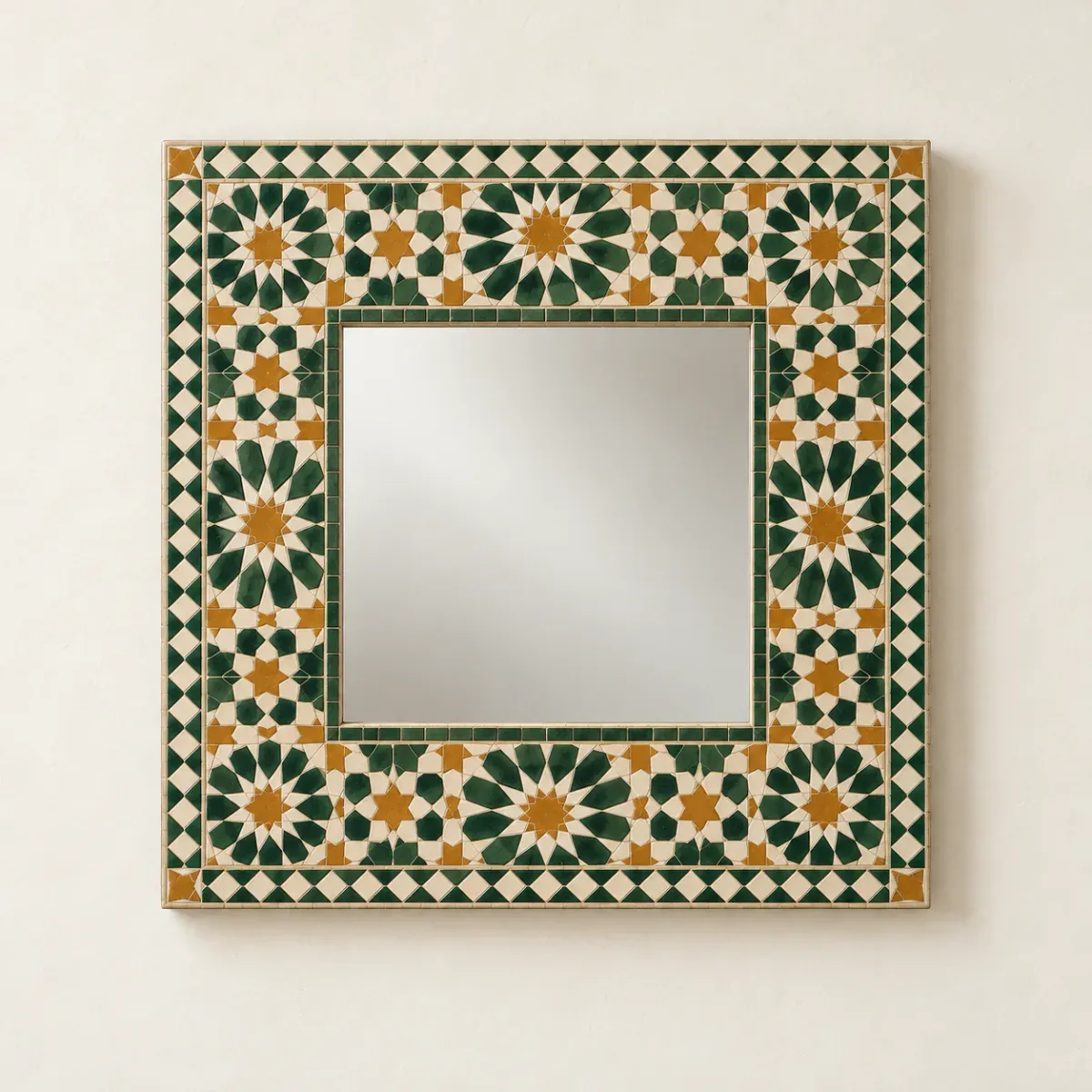
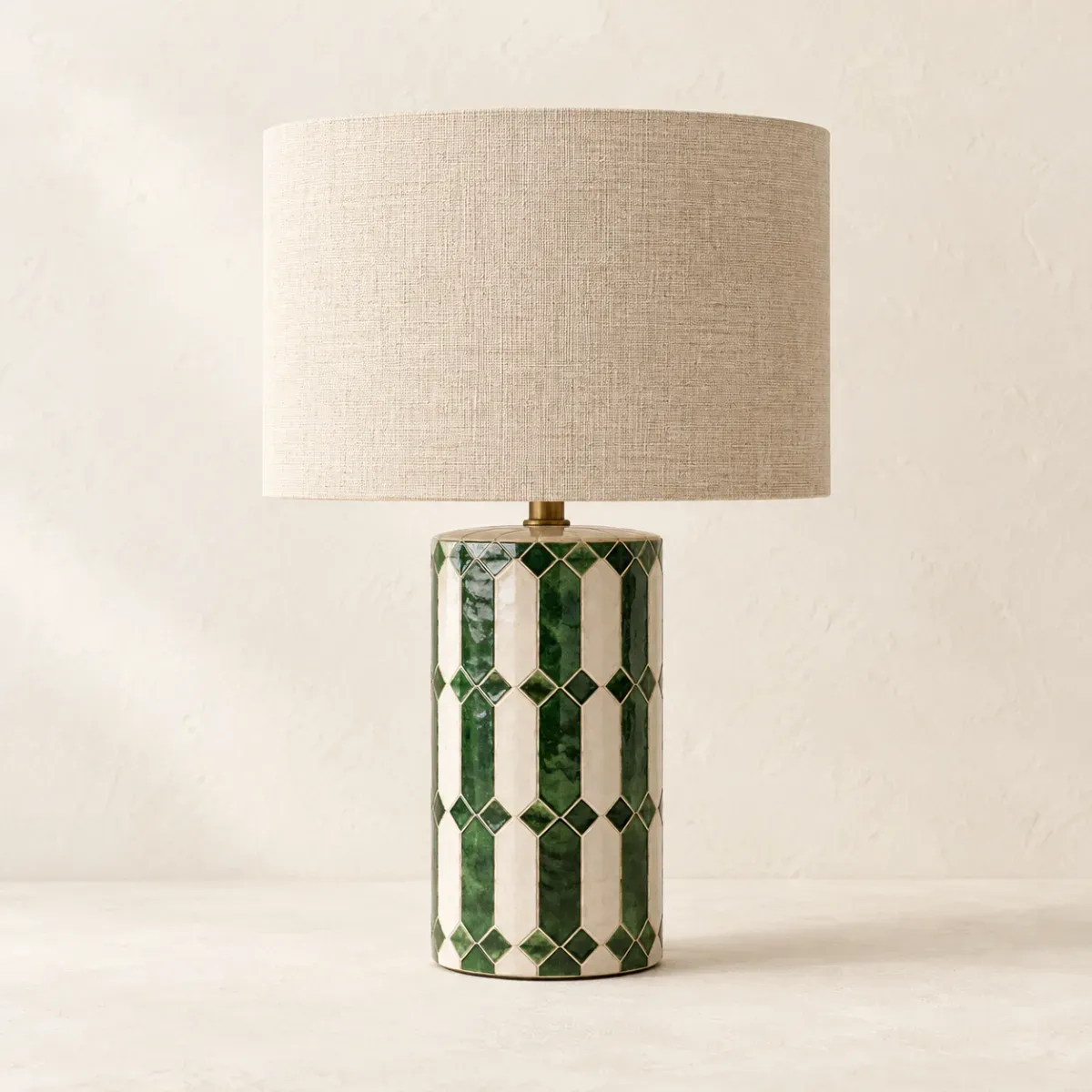
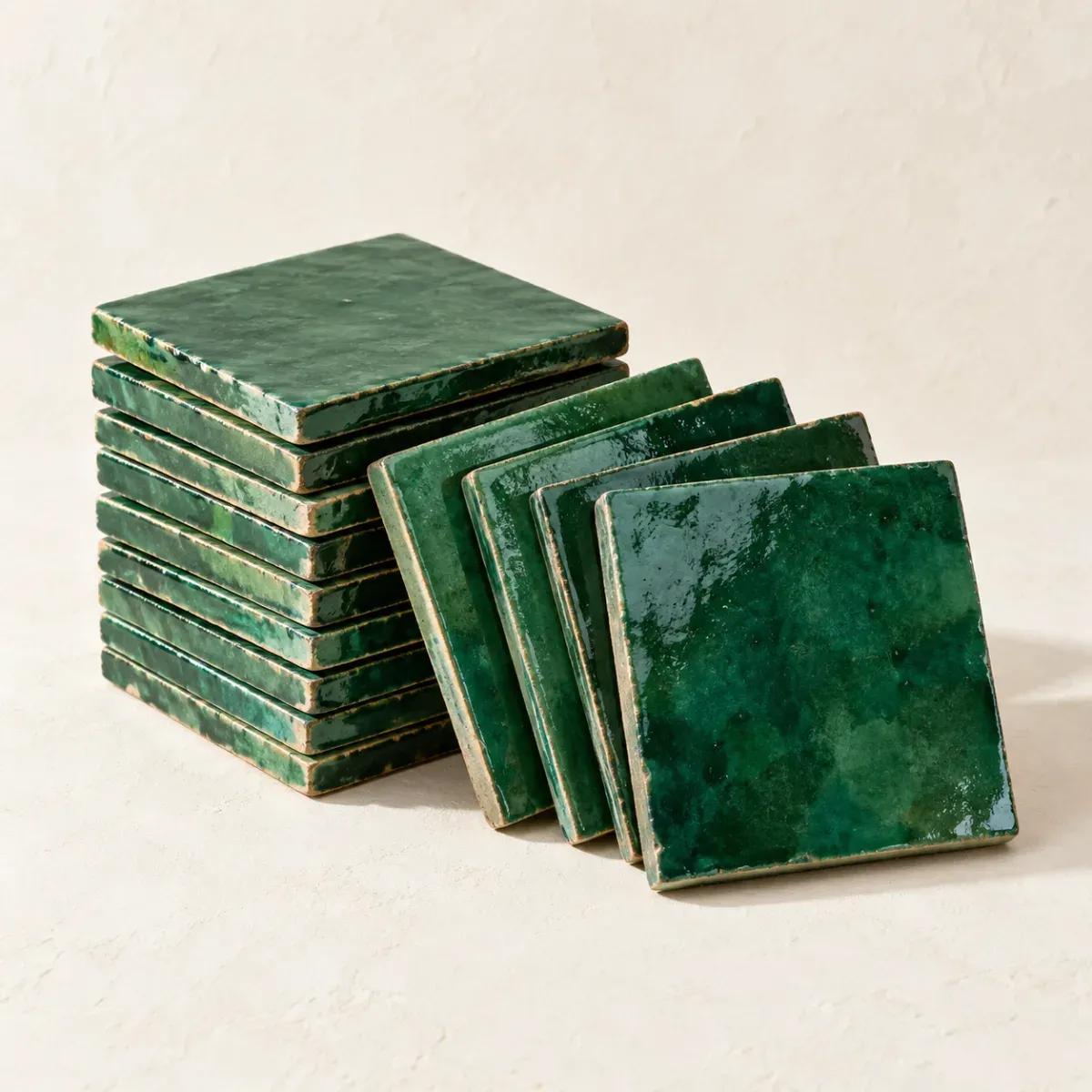
Tables, mirrors, lamps and tiles cut by hand in Fez and Tetouan.