
Geometry
Ruler, compass and hammer
A zellige pattern is never drawn freehand. It grows from a grid of polygons, from which lines leave at precise angles; the regions they enclose become the tesserae. Here are three real constructions, step by step.
The systems
Root two, root three
The eight-fold system (√2)
Squares and octagons: the dominant family in Morocco and Granada. It gives the 8- and 16-pointed stars and all their rosettes. Every ratio is a power of √2.
The six-fold system (√3)
Triangles, hexagons and dodecagons: it gives the 6-, 12- and 24-pointed stars. The great Fez rosettes with 48 and 96 points come from it.
The polygonal technique
Described by E. H. Hankin in 1925 and systematised by Jay Bonner: from the midpoint of each edge of a tiling, two lines leave at a fixed angle. Our patterns are generated this way, to the millimetre.
Rosette orders found in Morocco
- 8 khatem and eight-fold rosettes
- 12 ʿitnashari, the twelve-pointed star
- 16 al-Attarine, Bou Inania
- 24 arbaʿ wa ʿishrini
- 48 called “khamsini”, fifty
- 96 called “mi’ini”, hundred
See a sixteen-point rosette ringed by sixteen others, around a sun of forty-eight rays
Construction 1
The khatem: two squares at 45°
Draw a circle and an inscribed square, then the same square turned by 45°. The two outlines draw the eight-pointed star; their intersection, a regular octagon. The whole eight-fold system is already there.
Proportions
- Side of the square
- √2 · R ≈ 1.414 R
- Radius of the notches
- √(2 − √2) · R ≈ 0.765 R
- Side of the octagon
- (2 − √2) · R ≈ 0.586 R
- Angle of the points
- 90°
R: radius of the circle through the points. Star polygon of type 8/2.
Construction 2
The khatem field
Tile the plane with octagons and squares. From the midpoint of each edge draw two lines at 22.5° to the perpendicular: eight-pointed stars appear in the octagons, four-pointed stars in the squares, and elongated hexagons between them.
Proportions
- Repeat unit
- p = (1 + √2) · s ≈ 2.414 s
- Octagon side (our patterns)
- s = 5 cm
- Eight-pointed star
- ≈ 9 cm, cut from a 10 cm tile
- Contact angle
- 22.5° = 180° / 8
Family of the Marinid panels of Fez (Bou Inania, al-Attarine); method after Hankin (1925) and Bonner (2017).
Construction 3
The sixteen-pointed rosette
At the centre, a star with sixteen sharp (45°) points. A hexagonal petal sits in each notch: its radial sides are as long as the star’s edges, its outer sides parallel to them. Sixteen petals close the crown.
Proportions
- Radius of the notches
- 0.689 R
- Petal shoulder
- 1.351 R
- Petal tip
- 1.720 R
- Angle of the points
- 45°
Sixteen-pointed stars with 45° points are recorded at the al-Attarine and Bou Inania madrasas (MIT Tiling Search). Values computed for a canonical rosette, not measured on a panel.
Our patterns
The site’s patterns, at real scale
Every pattern drawn on eMaroc comes from these constructions, at the scale of a real panel: on your screen, a millimetre of drawing is roughly a millimetre of wall.
-
Khatem field
- Symmetry
- Order 8, square lattice (p4m)
- Construction
- Polygonal technique on the 4.8.8 tiling, 22.5° angle
- Repeat
- 12.1 × 12.1 cm
- Reference
- Marinid panels of Fez
- Night glazes: manganese black, green, honey
- Marrakech glazes: terracotta, white, green
-
Stars and crosses
- Symmetry
- Order 8, square lattice (p4m)
- Construction
- 8/2 khatems point to point, qamarchouna between them
- Repeat
- 8.0 × 8.0 cm
- Reference
- Nasrid and Mudéjar dados; Kashan tiles
-
Twelve-pointed stars
- Symmetry
- Order 12, hexagonal lattice (p6m)
- Construction
- Polygonal technique on the 3.12.12 tiling, 30° angle
- Repeat
- 11.2 × 19.4 cm
- Reference
- Six-fold system of the Fez workshops
- Nasrid glazes: honey and green
- Night glazes
-
Six-pointed stars
- Symmetry
- Order 6, hexagonal lattice (p6m)
- Construction
- Polygonal technique on the hexagonal tiling, 30° angle
- Repeat
- 6.9 × 12.0 cm
- Reference
- Six-fold fields of northern Morocco and al-Andalus
- Chefchaouen blue and lime
Approximate scale: the real size on screen depends on your device. The files are generated by our geometry script and use no protected image.
In our collections
Zellige at home
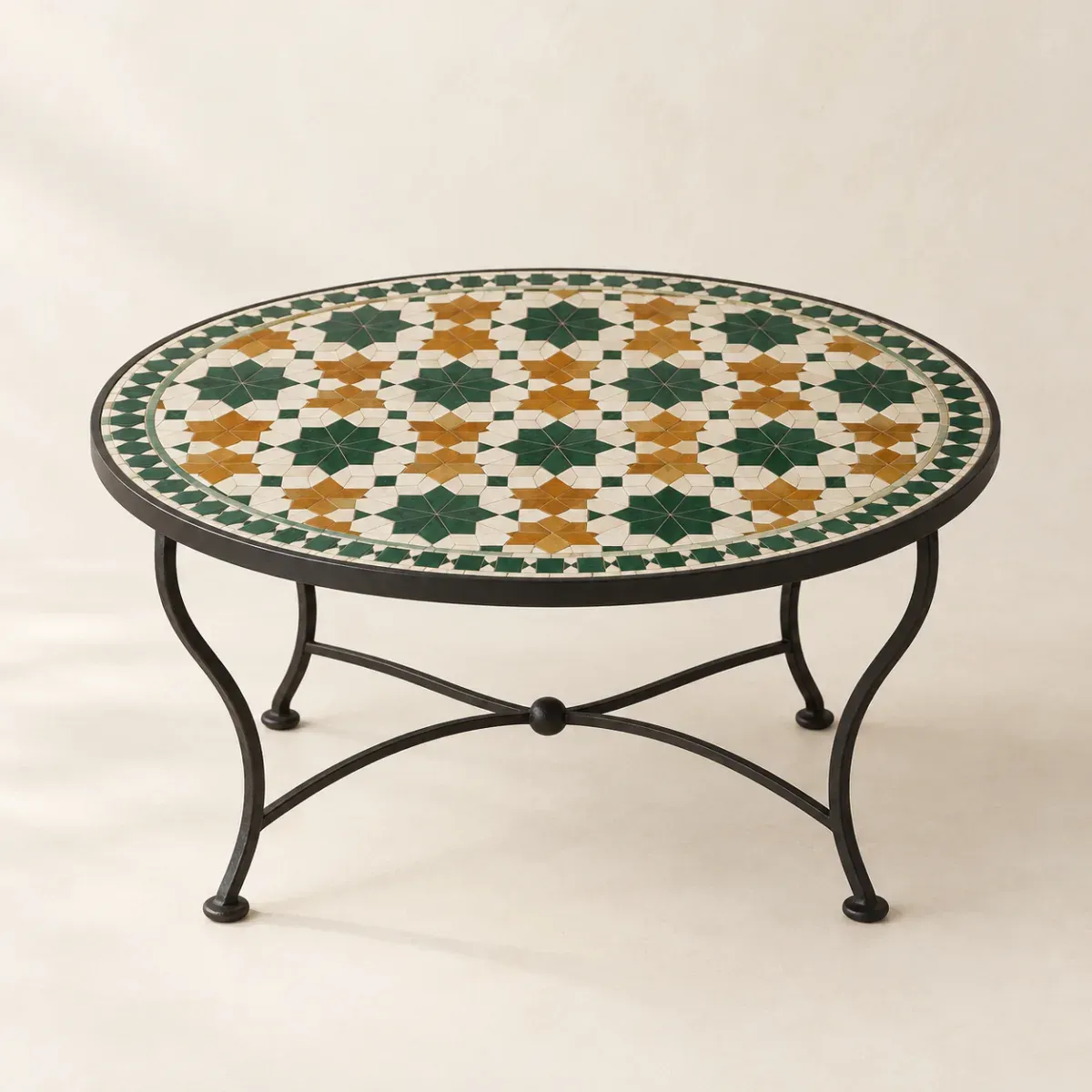
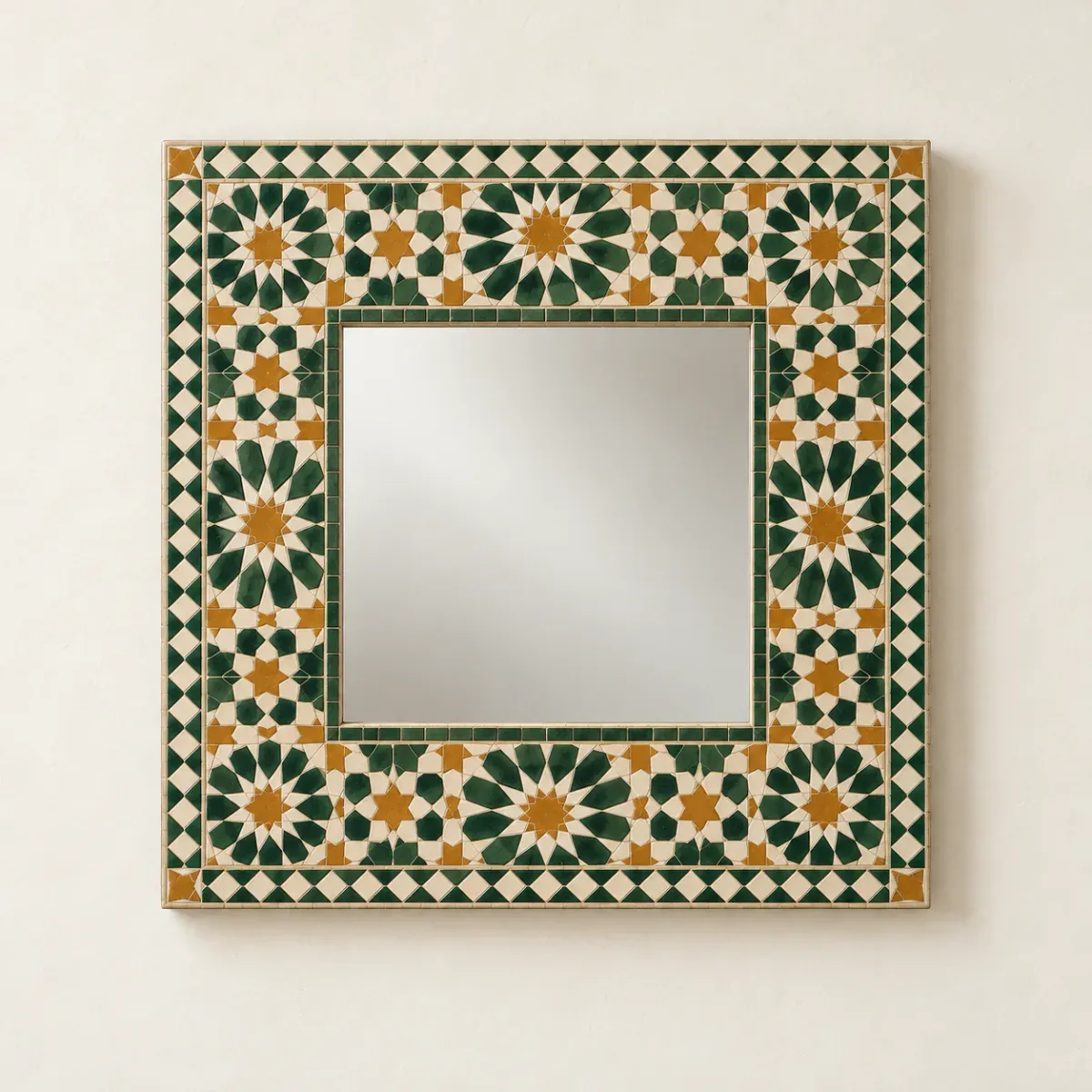
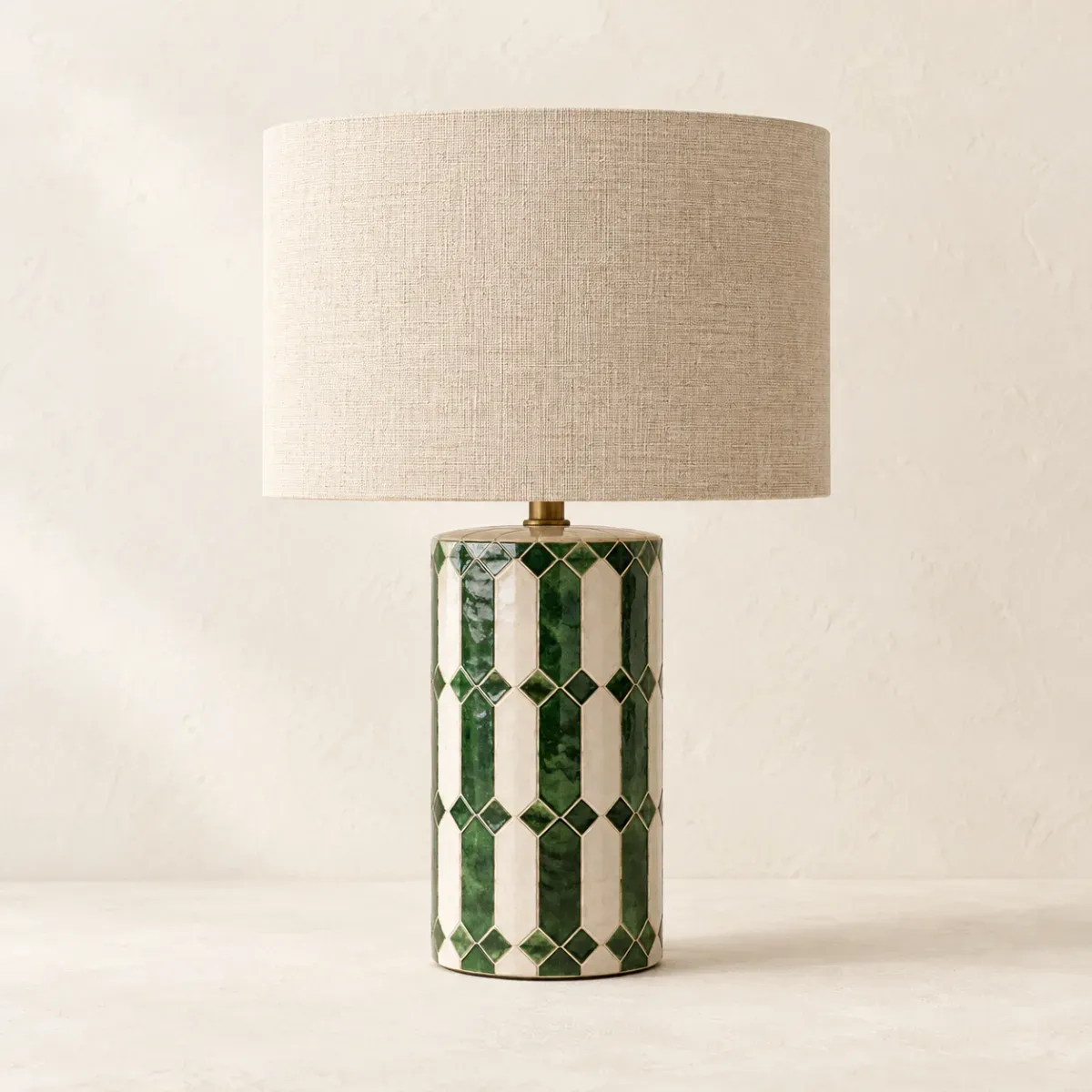
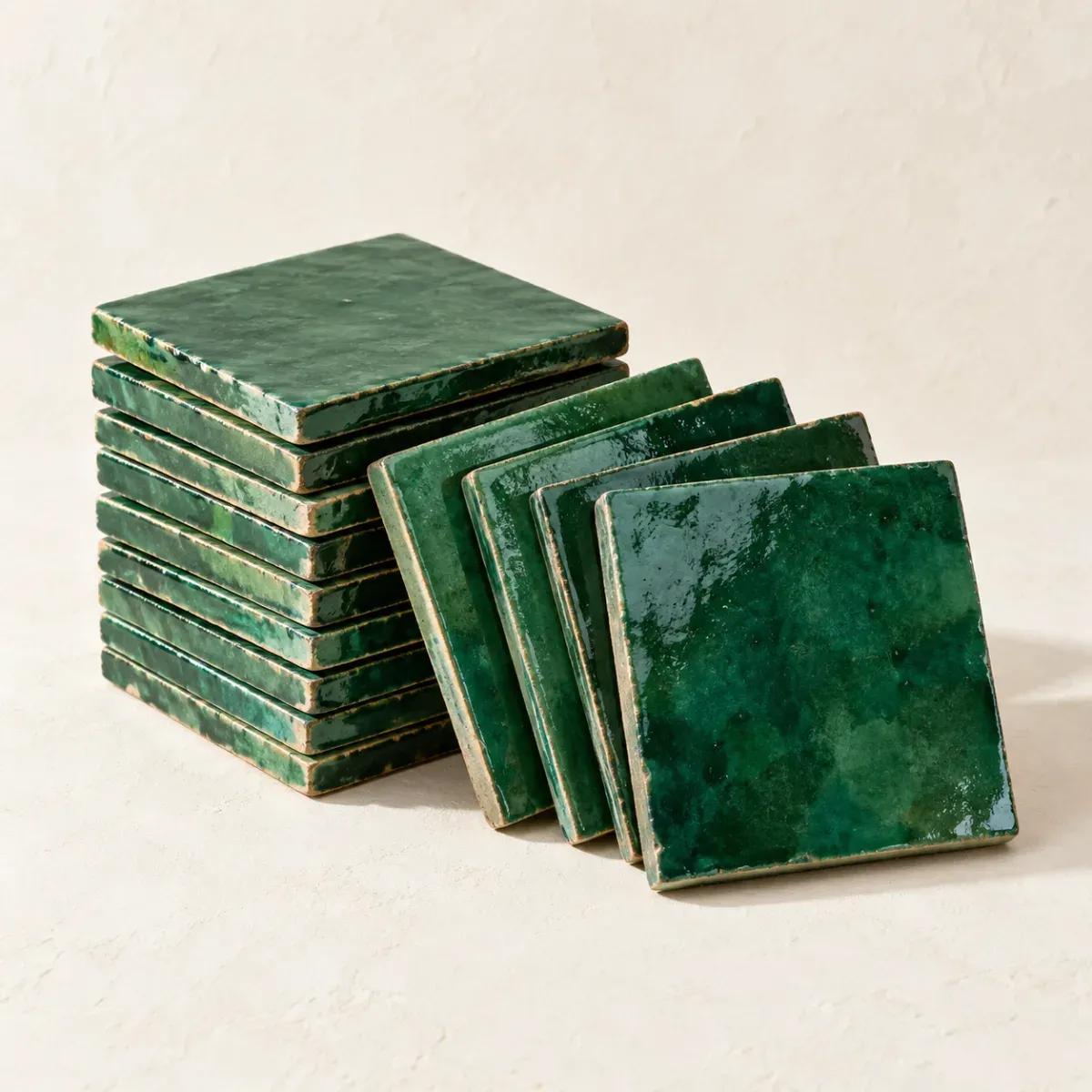
Tables, mirrors, lamps and tiles cut by hand in Fez and Tetouan.